Why Are We Fascinated by Unusual Faces? Portraiture Beyond Realism
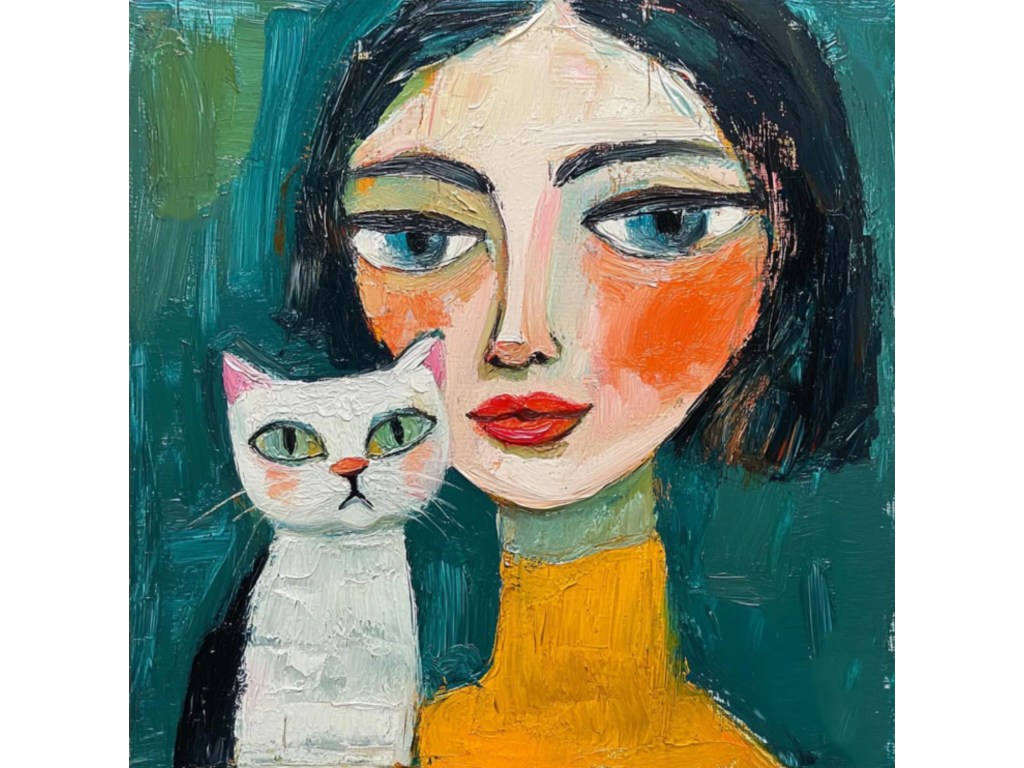
Woman with white cat. Oil painting on canvas. Art by Arsen
Why Are We Fascinated by Unusual Faces? Portraiture Beyond Realism
Large eyes, unexpected proportions, bold colors, and a touch of mystery. Why doesn’t a portrait have to be realistic to feel alive?
By Arsen | Art by Arsen
The human face is one of the most recognizable subjects in art. Just a few lines, two dots for eyes, and the suggestion of a mouth are often enough for us to recognize a human expression.
But why do some portraits disappear from our memory almost immediately, while others stay with us for years?
Sometimes, the answer has very little to do with anatomical accuracy. In fact, some of the most memorable portraits are those in which the artist deliberately moves away from reality.
Eyes become unusually large. Faces take on unexpected shapes. Skin colors no longer follow conventional expectations. And suddenly, a portrait develops a personality that photographic precision alone might struggle to capture.
My oil painting Woman and White Cat exists somewhere along this boundary between the familiar and the imagined.
Why Our Eyes Are Drawn to Eyes
When we look at a human face, the eyes are among our most important sources of visual information.
We use the direction of someone’s gaze to understand what has captured their attention. We search their eyes for clues about emotions, intentions, and personality.
Artists explored this aspect of human perception long before the development of modern psychology.
In some portraits, the subject looks directly at the viewer, creating an immediate sense of connection. In others, the gaze turns away, introducing a feeling of distance or introspection.
Things become particularly interesting when two characters appear in the same composition but look in different directions.
In my painting, the eyes of the woman and the white cat become two separate centers of attention.
The woman has large blue eyes emphasized by dark outlines. Her gaze drifts slightly to the side.
The cat has green eyes with narrow vertical pupils, creating an entirely different expression.
The result is a curious visual relationship: two characters sharing the same space while seeming to inhabit different emotional worlds.
Yet they are connected through a common visual language — enlarged eyes, simplified shapes, and expressive features.
When Incorrect Proportions Become the Right Artistic Choice
In traditional academic drawing, artists spend considerable time studying the proportions of the human face.
They examine the placement of the eyes, the structure of the skull, the distance between the nose and mouth, and the relationships between individual facial features.
But understanding these principles doesn’t mean an artist must always follow them.
During the early twentieth century, European art underwent a radical transformation in the way the human figure was represented.
Amedeo Modigliani created portraits with elongated necks, stretched faces, and almond-shaped eyes. These distinctive features became an essential part of his recognizable artistic language.
Pablo Picasso explored ways of depicting a face from multiple viewpoints simultaneously, challenging conventional ideas about perspective and representation.
Henri Matisse frequently treated color not simply as a tool for reproducing appearances, but as an independent means of artistic expression.
What connects these very different artists?
Each demonstrated that portraiture doesn’t necessarily have to be an exact reproduction of a person’s face.
A portrait can be an interpretation, an exploration of form, or an expression of a particular artistic vision.
In Woman and White Cat, I also use deliberate simplification.
The enlarged eyes, small lips, elongated face, and stylized anatomy create a character who feels more like an independent artistic personality than an attempt at photographic likeness.
What interests me is precisely this freedom — the possibility of transforming reality in the service of expression.
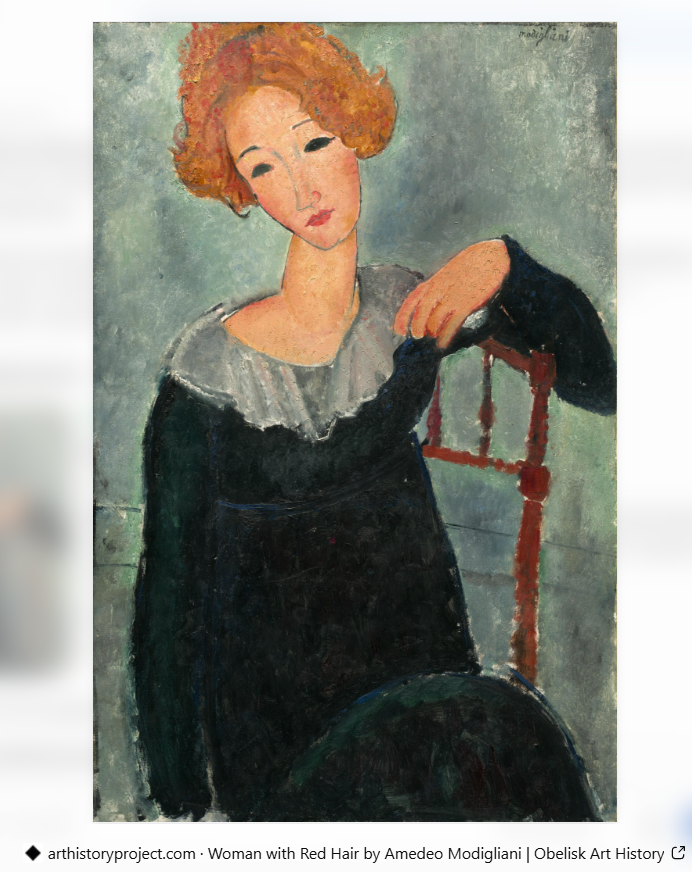
Amedeo Modigliani, Woman with Red Hair, 1917. Oil on canvas. National Gallery of Art, Washington, Chester Dale Collection. Public Domain.
Why the White Cat Changes the Entire Composition
Imagine this painting without the cat.
What remains is a portrait of a woman with dark hair, large blue eyes, bright cheeks, and a yellow sweater against a deep teal background.
But the presence of the white cat changes how we experience the entire image.
First, it introduces a contrast of shapes.
The woman’s face is built around elongated, flowing lines. The cat’s face is more compact, while its pointed ears introduce a different visual rhythm.
Second, the cat creates another gaze.
The viewer’s attention begins to move between the woman’s face and the animal’s expression.
Third, the cat’s white fur creates a significant area of brightness against the surrounding deep greens and turquoise blues.
As a result, the cat becomes much more than an additional character. It plays an essential role in the structure of the composition.
This illustrates an interesting principle of painting: even a relatively small secondary subject can dramatically change how we perceive the main figure.
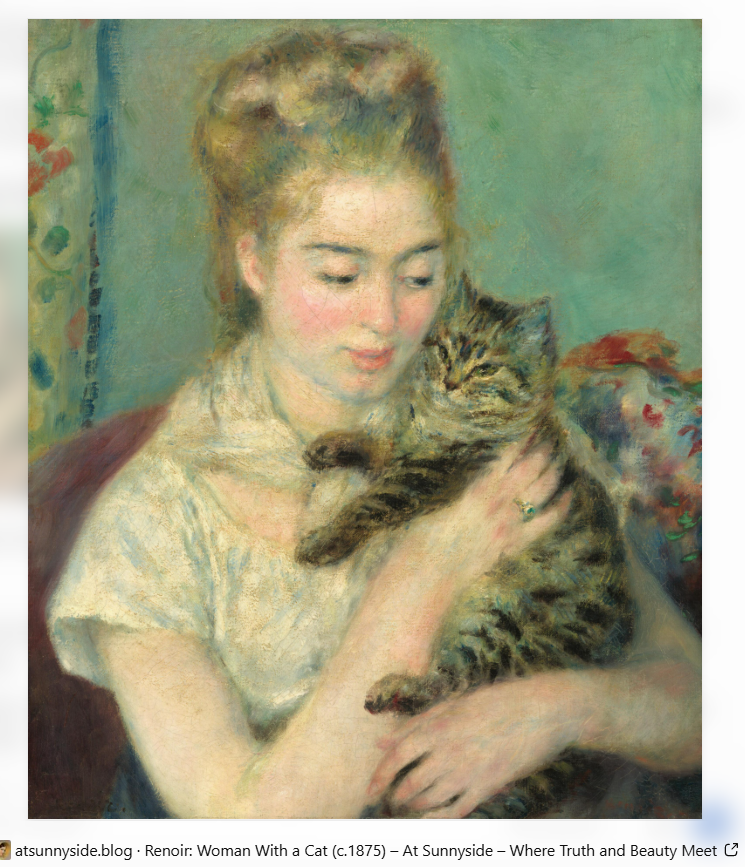
Pierre-Auguste Renoir, Woman with a Cat, c. 1875. Oil on canvas. National Gallery of Art, Washington. Public Domain.
Color Doesn’t Have to Be Realistic
In traditional painting, color often helps describe light, volume, and the physical qualities of objects.
But in expressive painting, it can serve a very different purpose.
Color can establish mood, organize a composition, and strengthen the character of an image.
Consider the palette of this painting.
Deep turquoise and green tones in the background contrast with the almost orange cheeks of the woman.
Her bright yellow sweater intensifies the contrast with the cool colors surrounding her.
The dark hair creates a strong visual frame around the pale face.
And the blue eyes become small but important accents within the composition.
Interestingly, the white cat isn’t painted entirely with white pigment either.
Its fur contains subtle gray, cream, and cooler tones, while individual passages are influenced by the colors surrounding them.
These relationships are what make painting so fascinating to me.
An artist doesn’t necessarily need to reproduce colors exactly as they appear in nature, as long as the colors establish a convincing visual harmony within the painting itself.
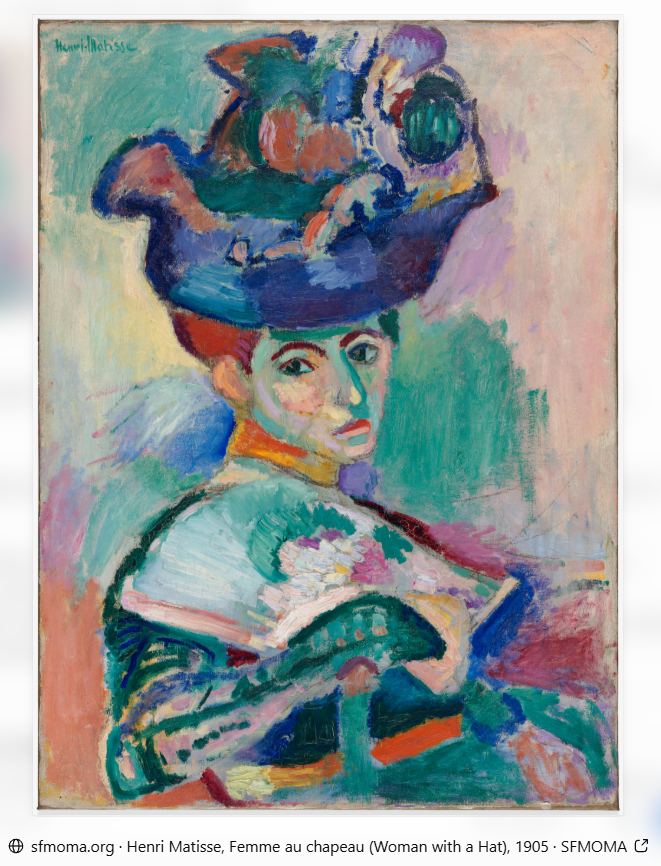
Henri Matisse, Woman with a Hat (Femme au chapeau), 1905. Oil on canvas. San Francisco Museum of Modern Art.
Why Visible Brushstrokes Make a Painting Feel Alive
Contemporary digital imagery has accustomed us to perfectly smooth surfaces.
We’re surrounded by photographs and digital images in which the process of creation is almost invisible.
Oil painting offers a very different experience.
When paint is applied thickly, the surface of the artwork develops genuine physical relief.
Every brushstroke has its own thickness, direction, and shape.
In my painting, this quality is particularly noticeable in the white cat and the textured background.
Individual ridges of paint remain visible, along with the marks left by brushes and palette knives.
When light strikes the painting from the side, these raised passages cast tiny shadows.
As a result, the artwork changes subtly depending on the lighting and the viewer’s position.
This is something that photographs can never fully reproduce.
Unlike a printed or digital image, an original oil painting exists not only as an arrangement of colors and shapes, but also as a physical object.
For me, this material quality of painting is especially important.
I don’t try to hide the evidence of how a painting was created. On the contrary, I enjoy allowing viewers to discover individual brushstrokes and artistic decisions.
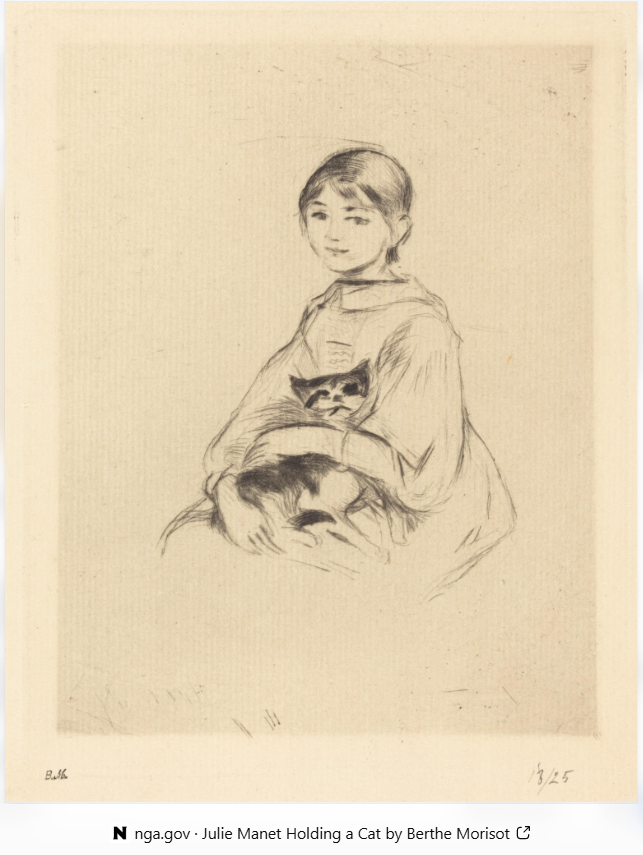
Berthe Morisot, Young Girl with a Cat, after a portrait of Julie Manet by Renoir, 1889. Drypoint. The Metropolitan Museum of Art, New York. Public Domain.
Why a Portrait Doesn’t Always Need a Story
In literature, characters reveal themselves through actions, dialogue, and events.
Painting works differently.
An artist has only one still image.
And yet that single image can be enough to suggest an entire story.
Sometimes, an unusual gaze, a slight tilt of the head, or the relationship between two figures is all that’s needed.
In Woman and White Cat, almost nothing happens.
The characters aren’t engaged in any particular activity. They simply exist beside one another.
Yet the difference between their gazes, the exaggerated proportions, and the contrasting colors create a visual tension that holds our attention.
I enjoy paintings that don’t insist on a single interpretation.
Instead, they invite viewers to examine details, discover their own associations, and gradually notice new aspects of the image.
Perhaps this is one reason unusual portraits can sometimes be more engaging than perfectly realistic ones.
They don’t simply show us a face.
They encourage us to think about how we perceive faces in the first place.
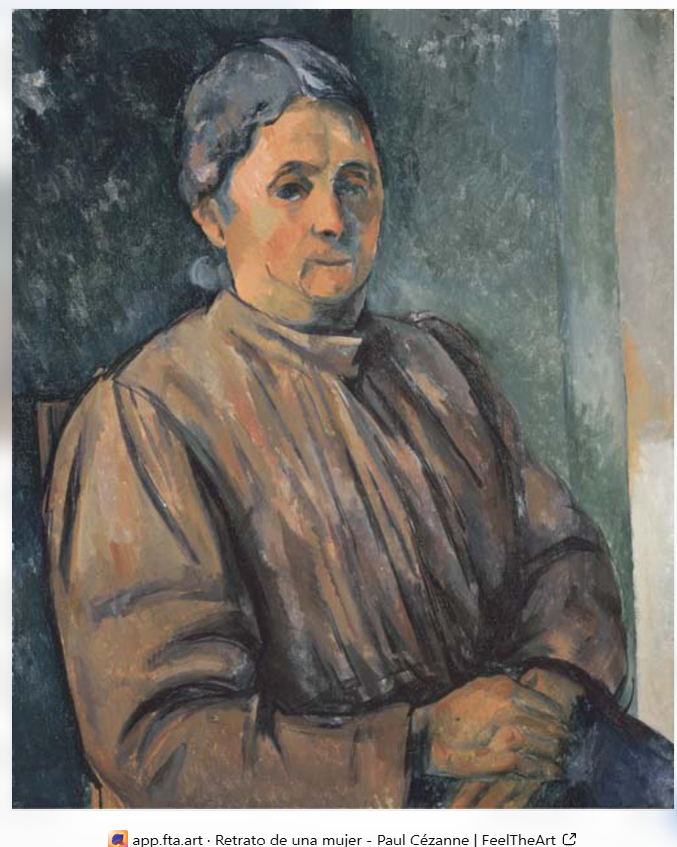
Paul Cézanne, Portrait of a Woman. Oil on canvas. The Metropolitan Museum of Art, New York. Open Access / Public Domain.
Art Doesn’t Have to Copy Reality
The history of painting demonstrates that expressiveness doesn’t always depend on accuracy.
Sometimes, an artist achieves more by stepping away from conventional rules.
Proportions can be altered. Contrasts can be intensified. Unexpected colors can be introduced. A brushstroke can be left deliberately rough.
These decisions allow an image to exist according to its own artistic logic.
In Woman and White Cat, I wanted to combine simplified forms, rich colors, expressive eyes, and the physical texture of oil paint.
I was interested in creating two characters who would capture attention not through a complicated narrative, but through their distinctive visual personalities.
Perhaps that is one of the most fascinating things about portrait painting.
To create a memorable face, an artist doesn’t always need to follow reality.
Sometimes, all it takes is learning to see it a little differently.
Watch the Painting Process
I documented the creation of Woman and White Cat in a painting process video.
You can watch how the composition gradually develops, how individual patches of color become recognizable faces, and how thick layers of oil paint create the texture and character of the finished artwork.
Explore more of my original oil paintings and contemporary figurative artwork at Art by Arsen.
— Arsen